Honey Bee Biology and Behavior Research Center
Our research center operates as a specialized research facility that comprehensively investigates the behavioral and biological characteristics of honey bees and makes original contributions to the field. A wide range of highly accurate and meticulously designed methodologies are employed in the studies conducted in our laboratory. Our research areas and infrastructure facilities provide researchers with scientific depth and flexibility in various aspects, supporting and enhancing the research process.
Our Research Areas
The main research and application areas conducted in our laboratory include:
Honey Bee PER Behavioral Analyses:
Behaviors such as sucrose responsiveness, water responsiveness, and olfactory learning are investigated to evaluate honey bees’ responses to environmental factors.
Honey Bee Cage Studies:
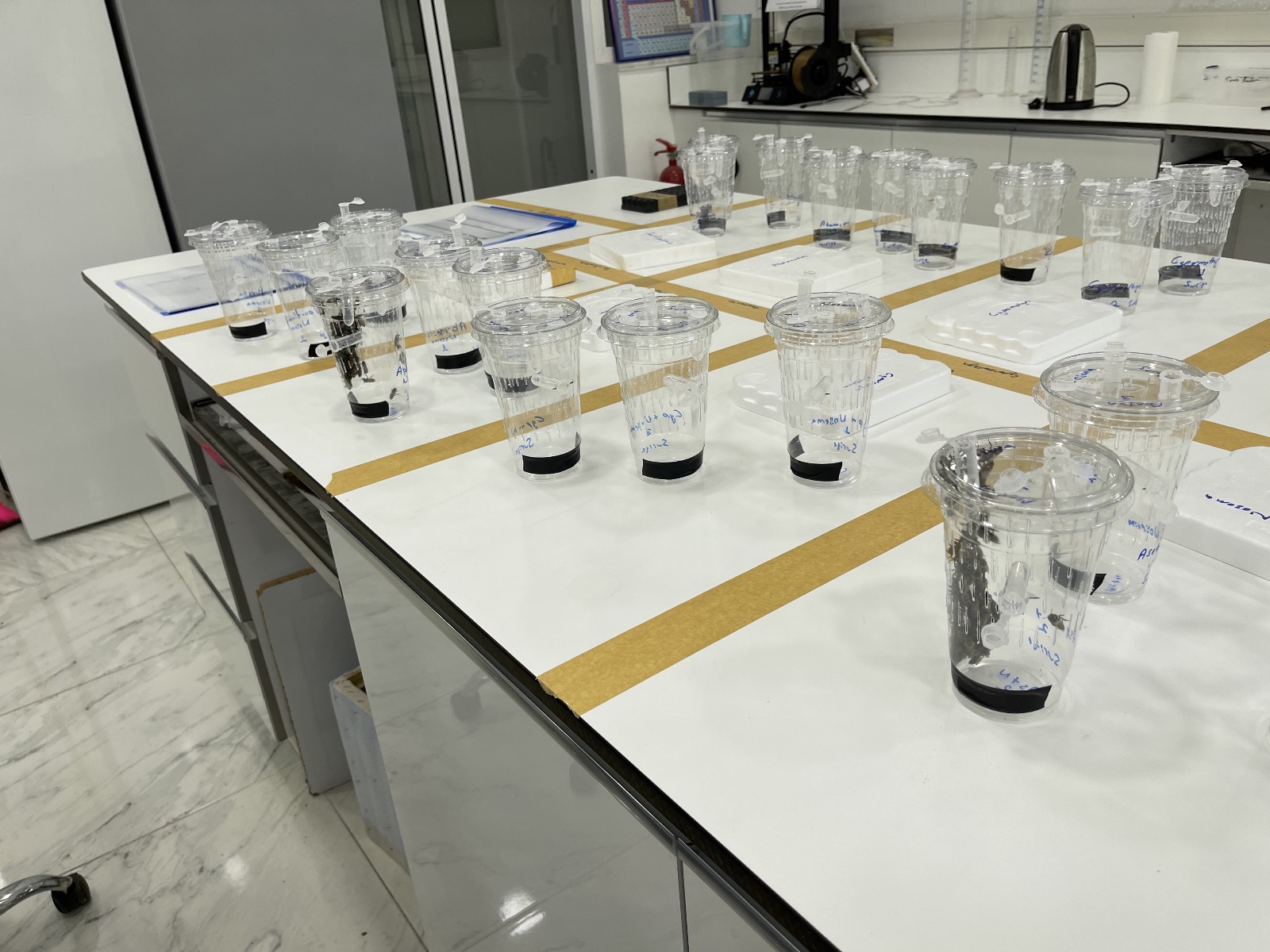
Behavioral and biological studies are conducted under controlled conditions to analyze the effects of various factors on honey bee health and performance.
Lifespan Analyses:
Studies are conducted to investigate honey bee longevity, with the effects of different environmental factors on lifespan being examined in detail.
Pesticide Toxicity Studies:
The toxic effects of pesticides on honey bees and their impacts on bee health are analyzed.
HPG Tissue Damage Studies:
Tissue damage occurring in the hypopharyngeal glands (HPGs) of honey bees is examined.
In Vitro Larval Rearing:
Honey bee larvae are reared under artificial laboratory conditions, enabling analyses of their different developmental stages.
Nosema Studies:
Research on Nosema disease investigates disease transmission rates, interactions with stress factors, and the effects of the disease on honey bee colonies.
Heavy Metal Toxicity Studies:
The effects of heavy metals on honey bee health and colony performance are investigated in detail.
In Vitro Production of Specially Contaminated and Adulterated Honey:
Special honey samples are produced under controlled laboratory conditions according to different contamination and adulteration scenarios. These include pesticide-contaminated honey, heavy-metal-contaminated honey, and honey adulterated at different ratios.
Anatomical Studies:
Abdominal dissections of queen and worker bees are performed to facilitate detailed investigations of their internal organs.
Our Laboratory Infrastructure
Our laboratory is equipped with advanced equipment carefully selected to support honey bee biology and behavioral research:
Incubators:
Two incubators with capacities of 1,000 liters and 270 liters are available to provide controlled temperature and humidity conditions.
Vacuum Oven:
An advanced vacuum oven is used for precise drying and moisture removal processes.
Light Microscope:
High-resolution imaging is used for detailed microscopic examinations.
Autoclave:
A high-pressure autoclave is used for sterilization procedures.
UV Sterilizer:
A UV sterilization system is used to maintain microbiological cleanliness in the laboratory environment.
3D Printer:
A 3D printer is used to manufacture customized apparatus, components, and experimental parts.
Vortex Mixers and Magnetic Stirrers:
Modern mixing devices are used to ensure the homogeneous mixing of samples.
Precision Balances:
High-precision balances are used to accurately measure samples with low mass.
Ongoing Research Projects
Our laboratory actively conducts a variety of research projects supported by national and international research funding programs. Our research team contributes to scientifically valuable studies and carries out pioneering projects in the field of honey bee biology and behavior research.
TÜBİTAK 1001 Projects:
Three TÜBİTAK 1001 projects supported by the Scientific and Technological Research Council of Türkiye (TÜBİTAK) are currently ongoing in our laboratory.
European Union Projects:
Two European Union-funded projects are being conducted within the framework of international collaborations, focusing on innovative research activities.
Doctoral Research:
One doctoral research project in the field of honey bee behavior and biology is currently ongoing.
TAGEM Projects:
Comprehensive studies on honey bee health and performance are being conducted through various projects supported by the General Directorate of Agricultural Research and Policies (TAGEM) of the Ministry of Agriculture and Forestry of the Republic of Türkiye.
These projects shed light on important aspects of honey bee behavior and their interactions with environmental factors, contributing to significant developments in the apiculture sector.