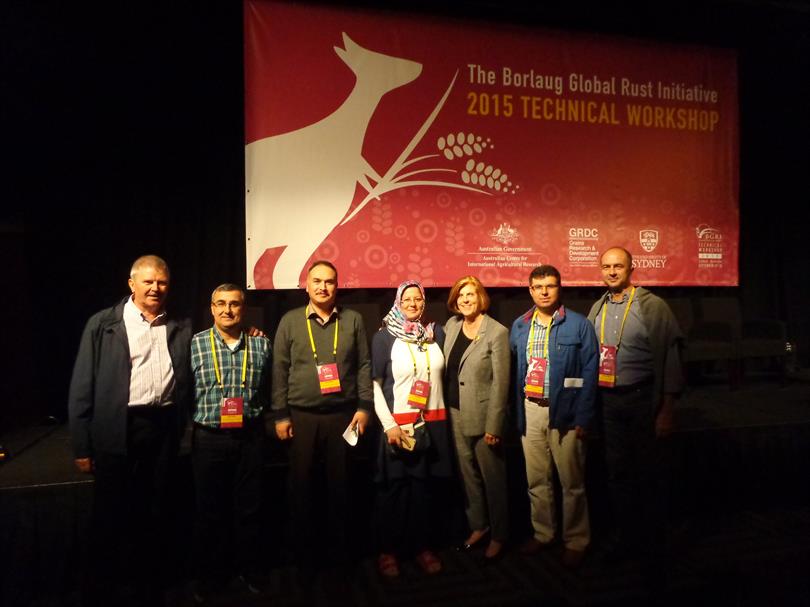
More than 400 participants from 60 countries met in Sydney, Australia to discuss rusts research innovations, global strategies and action on the ground at The Borlaug Global Rust Initiative (BGRI) at 17 - 20 September 2015.
BGRI is an International Consortium. (http://www.globalrust.org/about-bgri)
The Borlaug Global Rust Initiative (BGRI) is an international consortium of over 1,000 scientists from hundreds of institutions working together to:
- Reduce the world’s vulnerability to stem, yellow, and leaf rusts of wheat;
- Facilitate sustainable international partnerships to contain the threat of wheat rusts;
- enhance world productivity to withstand global threats to wheat security.
Key components of the BGRI include a global wheat community with systems for: cereal rust monitoring and surveillance; gene discovery; improved testing, multiplication and adoption of replacement varieties; training and capacity building; understanding non-host resistance to stem rust; and increasing levels of investments and coordination in wheat rust research and development.
The BGRI was initiated by ICAR, ICARDA, CIMMYT, UN-FAO and Cornell University in 2008. It is fostered by the Durable Rust Resistance in Wheat project, which serves as the secretariat.
Communication among the founding organizations led to adoption of a Charter for the BGRI. The Charter calls for an Executive Committee, and a general membership comprised of all organizations wishing to participate
Hosting the 2015 BGRI workshop is the Plant Breeding Institute of the University of Sydney. The PBI covers all aspects of plant breeding and its associated environments. . Representing leading international agricultural research centers, national research institutions, and policy organizations in rust-affected countries, the participants reviewed the latest science, practices, and policy options to improve global management options for control of rusts (Yellow, Leaf Stem) including the improved exchange of surveillance data, germplasm, and genetic information.
Seven posters were presented by Dr. Zafer Mert and Kadir AKAN. The titles of the posters are below:
- Rust reactions of lines in a wheat crossing block developed by the Bahri Dağdaş International Agricultural Research Institute in 2014
- Rust reactions of wheat lines developed by anther culture
- Rust responses of some Turkish, white grained, bread wheat genotypes in preliminary yield trials
- Responses of some Turkish winter durum wheat genotypes in preliminary yield trials to stem, leaf and stripe rusts
- The reactions of winter wheat stem rust resistance sources to stem, leaf and stripe rusts in 2014
- Reactions of spring wheat genotypes in crossing block nursery to stem, leaf, and stripe rust
- Identification of stripe rust resistant selections from wheat landraces currently under cultivation in Turkey
- Plant Breeding Institute (PBI- Plant Breeding Institute) (University of Sydney) has been visited by participant.